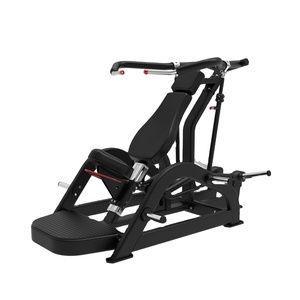
In the global commercial fitness manufacturing landscape, China has evolved from a high-volume component producer to the epicentre of advanced biomechanical engineering and heavy-duty strength equipment manufacturing. As commercial fitness facilities, athletic training centers, and global distributors source high-performance equipment, the Plate-Loaded Hack Squat Machine stands as a benchmark product. It demands rigorous dynamic balance, precise vector resistance, and industrial-grade structural integrity.
A premium commercial hack squat machine is not merely welded structural tubing; it is an engineered machine operating under compound loads exceeding 600 kg. Sourcing directly from top-tier Chinese manufacturers allows international buyers, commercial gym owners, and fitness equipment brands to achieve superior cost-to-performance ratios while retaining complete customization over biomechanics, frame metallurgy, and aesthetic branding.
Commercial-grade strength machinery requires cold-drawn structural steel tubing with wall thicknesses ranging from 3.0 mm to 4.0 mm. China's leading exporters utilize 50x100mm rectangular or oval steel profiles, ensuring zero frame deflection during max-load kinetic transfers.
Using case-hardened alloy linear guide shafts paired with industrial-grade linear ball bearings, modern hack squat machines guarantee friction-free sled travel along a precise 45-degree angle, minimizing shear force on the patellar tendon.
High-density EVA molded foam padding enveloped in commercial-grade anti-microbial PU leather supports the lumbar region. The shoulder-pad angle is contoured to distribute load across the trapezius without compressional stress on the cervical spine.
The primary objective of a commercial hack squat is isolating the quadriceps (rectus femoris, vastus lateralis, and vastus medialis) while stabilizing the spinal column. OEM manufacturers in Shandong and Guangdong utilize computer-aided finite element analysis (FEA) to design variable-angle footplates (adjustable between 30° to 45°), allowing lifters to maintain heel contact and optimize knee joint alignment throughout the full range of deep knee flexion.
Understanding the component-level variance between light-commercial gym equipment and true heavy-duty commercial strength machinery is crucial for B2B procurement officers and equipment importers.
| Specification Parameter | Light Commercial Standard | Hartis / Class S Commercial Grade | Procurement Advantage |
|---|---|---|---|
| Main Frame Steel Gauge | 1.5 mm – 2.0 mm (Q195 Steel) | 3.0 mm – 4.0 mm (Q235 / Q345 Steel) | Prevents structural fatigue and frame flex under 500kg+ static loads. |
| Sled Guide Mechanism | Nylon Wheels on Square Tubing | Hard-Chrome Shafts & Linear Bearings | Ultra-smooth kinetic path with zero friction wear or track grooving. |
| Finish & Surface Coating | Single Layer Powder Paint | Dual-Coat Electrostatic Powder Coating | Resists sweat corrosion, impact chipping, and UV degradation. |
| Footplate Adjustment | Fixed Angle Footplate | Multi-Angle Laser-Cut Steel Footplate | Accommodates diverse anatomical proportions and squat stances. |
| Safety Catch System | Manual Single Pin Stop | Dual-Linkage Heavy-Duty Auto Safety Handles | Protects users at failure points without needing an external spotter. |
| International Standard | GB 17498-2008 Basic | EN ISO 20957-1 Class S Certified | Full regulatory compliance for commercial fitness facilities in EU/US. |
As the global commercial fitness industry transitions toward specialized training environments—including Hyrox facilities, high-intensity strength clubs, and body-recomposition boutique gyms—the demand profile for strength equipment is undergoing a rapid evolution. Sourcing directors must anticipate these macro-environmental shifts to maintain market competitiveness:
Facility operators are increasingly requesting multi-axis biomechanical movement patterns. Dual-function hack squat and pendulum squat platforms maximize floor footprint efficiency while serving hyper-focused hypertrophy demands.
Equipment is no longer just functional metal; it is an extension of the facility's brand identity. Modern Chinese factories offer low-MOQ custom powder-coat RAL matching, custom leather stitching, and CNC laser-cut brand logos embedded into weight horn brackets.
The integration of IoT sensors into plate-loaded machines allows real-time velocity-based training (VBT) data collection. Factory-fitted magnetic sensor mounts are becoming a standard option for premium commercial gym equipment orders.
When partnering with established Chinese manufacturing hubs, B2B buyers bypass intermediary trading markups and gain direct access to robust engineering capabilities, stringent quality assurance protocols, and complete logistics integration.
Our manufacturing philosophy eliminates supply chain friction. From raw steel laser cutting and robotic seam welding to final DDP (Delivered Duty Paid) shipping, every step is optimized for accountability and product longevity.
We control every phase: 3D CAD modeling, robotic laser cutting, automated jig welding, and zero-defect quality control walk-arounds prior to container loading.
Customs duty, sea freight logistics, import clearance, and tail-lift unloading are fully handled. The price quoted is the exact landed cost at your installation door.
Backing our metallurgical standards with a clear, component-level warranty: 10 years on welded frames, 2 years on linear bearings, and instant dispatch of EU wear-parts stock.
Receive a comprehensive 3D scaled layout, component specification pack, and landed DDP cost estimate within 3 working days. No obligation, no middleman markups.
