0%

Choosing the right strength equipment shapes how people train, move, and return to the gym. A Cable crossover machine offers adjustable resistance, smooth movement, and many exercise options in one compact station. Users can perform chest presses, flyes, rows, pulldowns, rotations, and controlled rehabilitation movements. That flexibility matters when a gym serves beginners, athletes, and older members.

“Resistance training should be challenging, controlled, and specific to the individual,” says Dr. Jim Stoppani, an exercise scientist and fitness industry educator. His view reflects the practical value of a Cable crossover machine. The independent pulley handles allow users to train each side separately. This can expose strength differences that a barbell may hide. Small adjustments can also change the exercise angle, grip, and range of motion.

The machine feels approachable.

It also demands judgment.

A lighter setting may improve technique, while excessive weight can shorten movement and encourage swinging. That weakness should not be ignored. No machine automatically creates effective training. Coaches still need to teach posture, breathing, shoulder control, and gradual progression. They must inspect cables, pulleys, attachments, and weight stacks regularly.

For commercial gyms, the appeal extends beyond exercise variety. One station can support personal training, group instruction, and independent workouts. Its vertical design may also preserve valuable floor space. Still, layout, user traffic, maintenance access, and member skill levels deserve careful review. A Cable crossover machine is not merely a purchase. It is a long-term training decision, with benefits that depend on sound programming and consistent supervision.
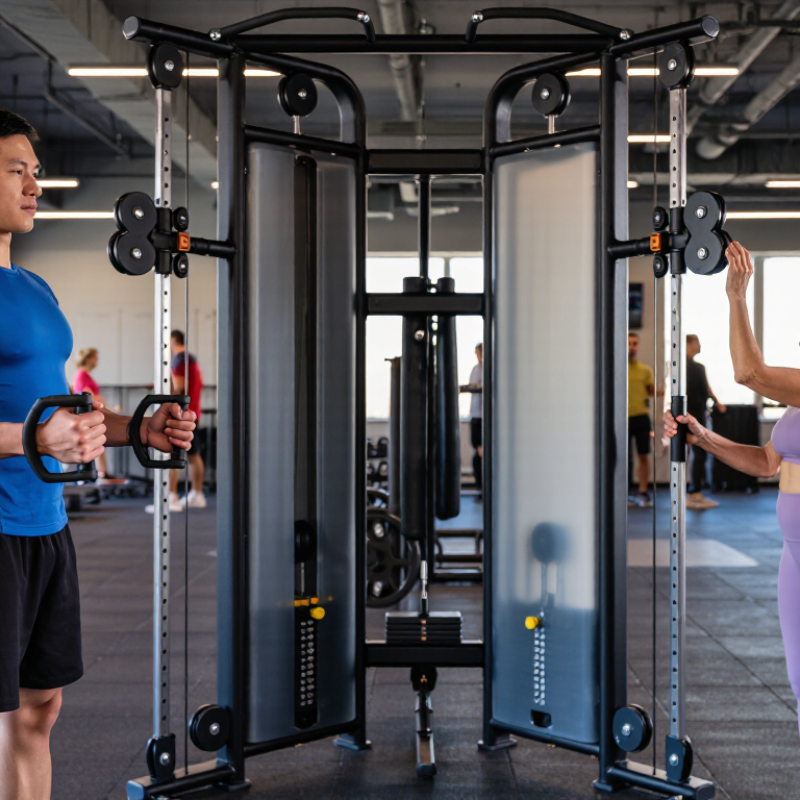
Why Choose a Cable Crossover Machine for Your Gym?

What Is a Cable Crossover Machine?

A cable crossover machine is a strength-training station with two upright towers and adjustable pulleys. Steel cables connect the pulleys to weight stacks or external resistance. Users attach handles, bars, or ankle straps to the cable ends. The pulley height can change from floor level to above shoulder height.

That adjustable design creates many training options. You can perform chest flyes, standing presses, rows, lateral raises, triceps pushdowns, and cable rotations. One arm can work independently, which helps address strength differences between sides.

Unlike many fixed-path machines, the cables allow more natural movement. Your hands can travel across several angles while your body stabilizes the load. Small details matter.

From practical gym use, cable resistance feels consistent through much of each repetition. It can challenge muscles during both lifting and returning phases. However, a cable crossover machine does not automatically improve technique. Excessive weight may pull the body forward or twist the hips. I have seen users focus on the weight stack while losing control of the handle. That is a useful warning.

Set the pulley at the correct height and choose a manageable load. Keep the cable path clear, secure attachments properly, and maintain steady breathing. A qualified trainer can check posture and range of motion, especially for beginners. The machine’s versatility is valuable, but learning every adjustment takes time. That part is easy to underestimate.

How Cable Crossover Machines Support Versatile Workouts

A cable crossover machine gives a gym more than two adjustable handles. It creates a flexible training station for pressing, pulling, rotating, and resisting movement. Each pulley can change the line of force, so one frame supports many exercise angles. In practical coaching, this variety helps members train the chest, back, shoulders, arms, hips, and core without moving across the gym. Less waiting time matters during busy sessions.

Set the pulleys high for cable flyes, triceps pressdowns, or diagonal pulls. Move them low for curls, rows, and controlled hip work. Keep them at chest height for presses and anti-rotation exercises. Small changes in height can alter the challenge noticeably. The cables also maintain tension through much of the movement, encouraging deliberate control rather than momentum. Start light. Smooth repetitions reveal technique problems quickly.

The machine suits beginners, athletes, and older adults because resistance can be adjusted in small increments. A trainer can cue a neutral spine, stable feet, and a pain-free range. I have found it useful for teaching movement patterns before adding heavier free weights. Still, it is not a perfect solution. Poor pulley setup or rushed adjustments can make an exercise awkward. I sometimes overestimate its versatility and need to simplify the session. Clear instructions, regular inspections, and honest feedback keep the equipment useful and dependable.

Key Benefits for Strength, Mobility, and Muscle Development

Cable machines deserve attention for more than convenience. They support strength, mobility, and controlled muscle development in one compact station. ACSM’s 2024 Worldwide Survey ranked traditional strength training fifth among global fitness trends. That ranking reflects continued demand for measurable resistance work. Dual adjustable pulleys also allow presses, rows, split squats, and rotations from multiple angles. The changing cable angle challenges stabilizers without forcing a fixed path. It feels practical. However, it is not magic.

For muscle development, steady tension can keep a target muscle working through much of each repetition. Smaller load jumps make progression easier for beginners and returning members. WHO’s 2020 physical activity guidelines recommend muscle-strengthening work on at least two days weekly. A cable station can support that frequency with efficient full-body sessions. In practice, posture often decides the result. Ribs down, feet grounded, and a slow return matter more than dramatic weight. Mobility can improve through comfortable ranges, but pain is a warning, not a challenge. I still see users chase heavier stacks too soon.

Tips: Start with two weekly sessions. Use 8–12 controlled repetitions, then adjust load gradually. Test a half-kneeling press, cable row, and low-to-high lift. Film one set if technique feels unclear. Review it honestly. A trainer should check setup, especially for shoulder or lower-back concerns.

Why Choose a Cable Crossover Machine for Your Gym? - Key Benefits for Strength, Mobility, and Muscle Development

Practical training applications, programming guidance, and user benefits

Training Dimension How the Cable Crossover Supports It Example Exercise Primary Muscles Practical Prescription Main Benefit
Upper-Body Strength Provides continuous resistance through a cable path, allowing pressing and pulling exercises from multiple angles. Standing cable chest press Pectoralis major, anterior deltoid, triceps 3–4 sets of 6–12 repetitions; rest 60–120 seconds Develops pressing strength while requiring the user to control the handles throughout the movement.
Back and Pulling Development Independent cable paths can train each side separately and support horizontal or diagonal pulling patterns. Single-arm cable row Latissimus dorsi, rhomboids, trapezius, posterior deltoid, biceps 3 sets of 8–12 repetitions per side; controlled tempo Encourages balanced development and helps identify left-to-right strength differences.
Muscle Hypertrophy Offers adjustable resistance and varied line-of-pull options, making it easier to train muscles through different portions of their range of motion. Cable fly or cable lateral raise Chest, medial deltoid, depending on exercise selection 2–4 sets of 8–15 repetitions; stop with approximately 1–3 repetitions in reserve Supports progressive overload with precise load adjustments and consistent tension.
Shoulder Mobility Low-load cable movements can be performed at different heights and angles to train controlled shoulder motion. Cable face pull or external rotation Rear deltoid, rotator cuff, mid and lower trapezius 2–3 sets of 10–15 repetitions using a light, manageable load Combines mobility practice with active muscular control rather than passive stretching alone.
Core Stability Standing cable exercises create external forces that require the trunk to resist rotation, extension, or lateral flexion. Pallof press Obliques, transverse abdominis, rectus abdominis, glutes 2–4 sets of 8–12 repetitions per side or 15–30 second holds Improves trunk control while the arms move independently of the lower body.
Functional Movement Allows diagonal, unilateral, and standing patterns that resemble many everyday and sport-related movements. High-to-low cable chop Core musculature, shoulders, hips, and upper back 2–3 sets of 8–12 repetitions per side with stable foot positioning Trains coordination between the upper body, trunk, and lower body.
Unilateral Training Each handle can usually be used independently, enabling single-arm and single-side exercises. Single-arm cable press Chest, triceps, shoulder stabilizers, core 2–4 sets of 8–12 repetitions per side; begin with the weaker side Reduces dependence on the stronger limb and promotes balanced movement control.
Exercise Variety A single station can accommodate pressing, pulling, fly, raise, curl, extension, rotation, and anti-rotation exercises. Cable curl, triceps pressdown, reverse fly Arms, shoulders, chest, back, and core, depending on setup Select 4–6 exercises to cover major movement patterns Improves equipment versatility and supports full-body programming in limited floor space.
Accessibility and Control The user can select a manageable load, adjust body position, and perform exercises seated, standing, or kneeling. Seated cable row or half-kneeling press Target muscles vary with the exercise and body position Use 8–15 repetitions with a load that permits stable technique Makes it easier to modify exercise difficulty and maintain controlled movement quality.
Programming Efficiency Multiple exercises can be performed at one station with quick changes to attachment, height, stance, or load. Upper-body circuit or full-body circuit Full body, depending on exercise selection Perform 3–5 exercises for 2–4 rounds with 30–90 seconds between exercises Supports efficient individual workouts, small-group sessions, and circuit-based training.

Note: Training loads and repetition ranges should be adjusted according to exercise technique, training experience, health status, and individual goals. The exact adjustment range and resistance ratio vary by machine design.

How to Choose the Right Cable Crossover Machine

A cable crossover machine supports pressing, pulling, rotation, and controlled isolation work in one station. Its adjustable pulleys help users train through different angles, which can improve exercise variety and coordination. However, choosing the right model requires more than checking its appearance.

Measure your available floor space, including room for plates, benches, and moving cables. Check the pulley height range and make sure both sides adjust smoothly. A stable frame matters, especially during single-arm exercises. Look for clear weight markings, secure locking pins, protected cable ends, and handles that feel comfortable after repeated sets. A machine with a very high weight stack may seem impressive, but it can waste space in a smaller gym.

Tips: Test the cable path before buying. Listen for grinding sounds. Check the warranty and maintenance guidance. Ask whether replacement cables and pulleys are readily available.

In practice, pulley spacing changes the training experience. Wide columns suit chest flyes and standing movements, while closer columns may fit compact rooms better. I once underestimated the importance of adjustment speed; slow pins interrupted busy sessions. That detail is easy to miss. Also inspect the floor anchors and frame movement during a strong row. If the structure shifts, users may lose confidence and control. Choose resistance that matches your members’ abilities, not only advanced athletes. A simple setup is often used more consistently.

Essential Safety, Setup, and Maintenance Guidelines

Why Choose a Cable Crossover Machine for Your Gym?

A cable crossover machine supports pressing, pulling, rotation, and controlled rehabilitation movements. Its adjustable pulleys help users train at different heights and angles. This flexibility suits beginners, athletes, and supervised older adults. However, versatility does not remove the need for careful preparation.

Place the machine on a level, solid floor with enough clearance around every handle. Check that bolts, pulleys, guide rods, and cable ends are secure before use. Keep the training area dry and free from loose plates or bags. Select a light resistance during the first movement. Watch how the cable travels. It should move smoothly, without scraping, jerking, or sudden slack. Stop immediately if the frame shifts or the cable shows broken strands. Small damage can become a serious failure.

Use controlled movements and avoid forcing a joint beyond its comfortable range. Staff should demonstrate the setup and explain the machine’s adjustment points. New users may need direct supervision, especially during overhead exercises. After each session, wipe contact surfaces and inspect handles for cracks. Lubricate moving parts only according to the equipment manual. Do not guess with household oils. I once overlooked a slightly loose pulley cover during a busy inspection. It was harmless that day, but the mistake changed my routine. Now I record inspection dates, resistance settings, and unusual noises. Maintenance logs feel tedious. They also reveal patterns before problems become expensive.

Why Choose a Cable Crossover Machine for Your Gym?

Essential safety, setup, and maintenance guidelines help keep cable crossover equipment reliable and safe for repeated use.

The chart shows practical preventive-maintenance intervals commonly used in gym equipment programs: inspect the machine before every workout, examine cables and attachments weekly, check fasteners and frame alignment monthly, review pulley movement quarterly, and schedule a comprehensive service every six months. Always prioritize the equipment manufacturer’s service manual and remove the machine from use if fraying, unusual noise, loose hardware, or damaged guards are found.

FAQS

What is a cable crossover machine?

It is a strength-training station with two upright towers and adjustable pulleys. Steel cables connect handles to resistance stacks.

What exercises can be performed on this machine?

You can perform presses, flyes, rows, lateral raises, curls, triceps pushdowns, and cable rotations. Many angles are possible.

How does adjustable pulley height affect training?

High pulleys suit flyes and pressdowns. Low pulleys support curls and rows. Chest height works well for presses.

Can the machine help correct strength differences?

Yes. Each arm can work independently. One side may reveal weaker control or a shorter range.

Why should users start with a light load?

Heavy resistance can pull your body forward or twist your hips. Light weight exposes technique problems quickly.

Is this machine suitable for beginners?

Yes, when resistance remains manageable. A qualified trainer should check posture, breathing, and pain-free movement.

What safety details matter during a workout?

Keep the cable path clear. Secure each attachment firmly. Use stable feet and steady breathing.

Does the machine automatically improve exercise technique?

No. The equipment cannot replace careful control. I sometimes focus too much on the weight stack.

How can the machine support efficient gym sessions?

One station supports pressing, pulling, rotation, and core work. This can reduce walking and waiting during busy periods.

What are the machine’s limitations?

Adjustments take practice. Poor setup can make movements awkward. Its versatility is useful, but not unlimited.

Conclusion

A Cable crossover machine is a versatile strength-training station that uses adjustable pulleys, cables, and handles to create smooth resistance from multiple directions. Its flexible design allows users to perform exercises for the chest, back, shoulders, arms, legs, and core while standing, kneeling, or using a bench. By changing the pulley height, grip, stance, and resistance, one machine can support pressing, pulling, fly, rotation, and functional movement patterns for beginners and experienced athletes alike.

The main benefits include improved muscle development, better movement control, increased mobility, and more balanced strength training. When choosing a machine, consider its frame stability, pulley range, cable quality, weight capacity, available attachments, footprint, and adjustment system. Proper setup is also essential: secure the equipment, select a manageable load, maintain controlled technique, and keep the training area clear. Regularly inspect cables, pulleys, bolts, and handles, and follow a consistent cleaning and maintenance routine to support safe, reliable, and long-term use.

Clara Bennett

Clara Bennett

Clara Bennett is a marketing professional with a strong understanding of her company’s products, services, and the needs they are designed to meet. She regularly contributes expert articles to the company website, turning detailed product knowledge into clear, useful guidance for customers and......