Buying a Functional trainer cable machine can look simple until the details become expensive. A polished frame, bright pulley housings, and a heavy weight stack may attract attention. They do not automatically guarantee smooth training.
Dr. Jim Stoppani, a fitness researcher and exercise author, has said, “Cable machines offer constant tension through a wide range of motion.” That principle matters when comparing machines. A useful model should move quietly, track smoothly, and remain stable during presses, rows, rotations, and single-arm exercises. Check the pulley ratio carefully. A two-to-one system may feel lighter, but it can provide faster cable travel. A one-to-one system often delivers more direct resistance.
The right choice depends on the room and the user. Measure ceiling height, floor depth, and access through doorways. Leave space for a bench, attachments, and safe movement. Inspect the cable coating, carabiners, guide rods, welds, and adjustment points. Ask about replacement parts and warranty support. These details are easy to ignore.
Mistakes happen.
Even experienced buyers sometimes focus too heavily on maximum resistance. Smooth adjustment can matter more than an impressive number. A machine with poor ergonomics may collect dust beside the wall. That is not a small failure.
This guide presents ten practical tips for choosing a Functional trainer cable machine. It considers construction, safety, versatility, maintenance, user comfort, and long-term value. Some recommendations may seem obvious. They are still worth checking twice.
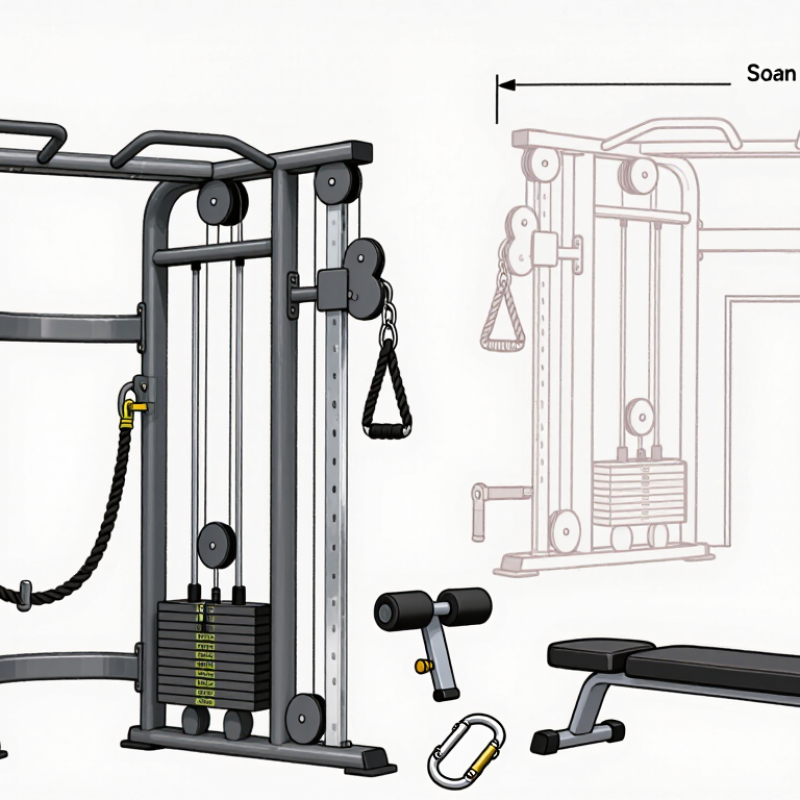
Before buying a functional trainer cable machine, define what you actually want to train. Strength, mobility, athletic movement, and rehabilitation require different setups. Write down your regular exercises, such as cable rows, squats, presses, and rotational pulls. This list reveals the attachments, pulley positions, and resistance range you may need. Do not choose a machine only because it looks powerful. That mistake is easy to make.
Tip 1: Measure your training area carefully. Record ceiling height, wall clearance, floor width, and doorway access. Leave enough room for a full cable extension and safe body movement. A machine may fit on paper but feel cramped during lunges or side pulls. Keep at least a clear walking path around moving parts. Check the floor, too. Uneven flooring can affect stability and alignment.
Tip 2: Match the machine to your real routine. If two people train together, independent weight stacks may save time. If you train alone, a smaller frame could provide better value. Consider whether you prefer fixed exercises or frequent adjustments. Adjustable pulleys offer versatility, but they also need more space and setup time. In my experience, users often overestimate how many attachments they will use. I have done that myself. Start with your strongest training habits, then allow room for gradual changes. A professional inspection of bolts, cables, and pulley movement can prevent avoidable problems.
Use the chart to compare typical floor-space requirements before choosing a functional trainer. The recommended training area includes approximately 1 metre of user clearance around the equipment and should be confirmed against the selected machine’s specifications.
How to use this guide: Compact single-column units suit smaller rooms and focused cable exercises. Dual-column trainers provide more exercise options but need additional clearance. Rack-integrated systems offer the broadest training potential and require the most floor space. Measure doorway access, ceiling height, storage space, and movement clearance before buying.
Frame strength is the first practical test. A machine should feel planted when both cables pull unevenly. Check welded joints, upright thickness, base width, and floor contact points. Thin tubing can flex noticeably under heavy resistance. That movement may reduce control and accelerate wear.
ASTM F2276-23 outlines safety and performance considerations for fitness equipment. Use it as a reference, not a marketing promise.
The 2024 Global Wellness Economy Monitor valued the physical activity economy at approximately $1.06 trillion in 2022. Rising demand makes careful equipment selection more important.
Inspect pulley housings, cable coatings, adjustment pins, and locking mechanisms.
They should move smoothly, without scraping or sudden release. Test every setting.
Look closely at the weight stack and guide rods. Plates should travel vertically and stop reliably. A guarded stack helps reduce accidental contact. The cable should remain aligned during single-arm movements.
I once accepted a rigid-looking frame without checking its anchor points. That was a poor judgment. Frame appearance can hide weak hardware.
Ask for load ratings, maintenance intervals, weld inspection details, and compliance documentation.
Measure ceiling height and training clearance before ordering. A small showroom test cannot reveal every long-term problem.
Recheck bolts after installation, then record unusual noise, looseness, or cable fraying.
A functional trainer should match your movement goals, not just your available floor space. ACSM’s 2024 Worldwide Survey ranked traditional strength training fifth among global fitness trends. That demand makes cable-system design worth examining closely. A dual adjustable pulley usually offers broader movement angles than a fixed station. Check whether each column moves smoothly from ankle height to overhead positions. Small details matter.
Test the pulley ratio before buying. A 1:1 system delivers the selected weight directly, which suits heavier rows, presses, and athletic pulls. A 2:1 system cuts the resistance roughly in half but provides twice the cable travel, making it useful for controlled raises and rehabilitation-style movements. Plate-loaded systems can reduce maintenance, while weight stacks allow faster transitions. Resistance bands add variable tension, but they may feel less predictable near the starting position. Feel the difference.
The Health & Fitness Association reported 72.9 million American fitness-facility members in 2023, a 5.8% increase from 2022. More users also mean more adjustment points, noise, and wear. Inspect bearings, cable coating, locking pins, and frame stability in person. I once underestimated handle spacing; wide attachments made pressing uncomfortable. That mistake still matters. Some published load ratings also reflect static testing, not repeated home use. Ask how the manufacturer tested them, then leave room for uncertainty.
| Tip | Buying Dimension | What to Compare | Typical Specifications or Options | Why It Matters |
|---|---|---|---|---|
| 1 | Choose the cable system | Independent or connected pulley systems | Dual independent adjustable columns; connected systems may use a shared frame or crossbar | Independent columns allow unilateral training, while connected systems can provide a more uniform setup for symmetrical exercises. |
| 2 | Check pulley travel | Vertical adjustment range and usable cable travel | Approximately 20–30 vertical adjustment positions; cable travel commonly ranges from about 1.8–2.5 m | A wide adjustment range supports movements from low rows and curls to high pulldowns and overhead exercises. |
| 3 | Understand resistance ratios | 1:1 versus 2:1 pulley ratios | 1:1 ratio: greater load and shorter cable travel; 2:1 ratio: approximately half the stack resistance and longer cable travel | The ratio affects effective resistance, speed, range of motion, and the amount of cable pulled during each repetition. |
| 4 | Evaluate the weight stack | Total stack capacity and increment size | Common total capacity: approximately 70–100 kg per column; increments often range from 2.5–5 kg | A suitable stack should cover light rehabilitation, general fitness, and heavier strength-training requirements. |
| 5 | Inspect pulley movement | Swivel range, smoothness, and locking mechanism | Pulley heads may rotate horizontally; adjustment should lock securely at each position with minimal side-to-side play | Smooth, controlled movement helps maintain consistent resistance and improves positioning for different exercises. |
| 6 | Compare cable quality | Cable construction, coating, and rated durability | Look for braided steel cable with a protective nylon or polymer coating and swaged end fittings | A coated, properly terminated cable reduces abrasion and helps protect the cable and pulley surfaces during repeated use. |
| 7 | Review attachment compatibility | Handle, strap, bar, and specialty attachment options | Useful basic set: single handles, ankle straps, a straight bar, a short bar, and carabiners | A broad attachment selection increases exercise variety without requiring additional equipment. |
| 8 | Measure the machine footprint | Overall dimensions, ceiling height, and training clearance | Typical freestanding units may be about 1.5–2.0 m wide, 0.8–1.2 m deep, and 2.0–2.4 m high | Allow additional space in front and to the sides for cable paths, bench movement, and safe exercise positioning. |
| 9 | Assess frame stability | Frame weight, base design, and anchoring provisions | Commercial-style units often weigh roughly 300–600 kg; wider bases and floor anchors improve stability | A stable frame minimizes movement during unilateral pulls, explosive exercises, and high-load training. |
| 10 | Check maintenance and safety features | Guards, adjustment labels, lubrication access, and replacement parts | Prefer enclosed weight stacks, visible position markers, accessible cable inspection points, and replaceable wear components | Clear adjustments and serviceable parts improve operating safety, reduce downtime, and extend equipment life. |
Buying a functional trainer requires more than checking its frame and weight stack. Adjustability determines whether the machine fits your body, training style, and available space. Test each pulley from the lowest position to the highest setting. The movement should feel controlled, without grinding or sudden drops. Confirm that adjustment pins lock firmly and remain easy to reach during a workout. A useful machine should accommodate pressing, rowing, cable crossovers, and rotational exercises without awkward repositioning.
Attachments also deserve close inspection. Look for two handles, a straight bar, an ankle strap, and a pull-up option if possible. Handles should feel secure, but they should not pinch your hands. Check the cable length with both pulleys extended. Short cables can restrict exercises, especially for taller users. User-friendly design includes clear markings, smooth wheels, comfortable grips, and storage that keeps attachments off the floor. Small details matter.
I once underestimated the value of a quiet pulley system. That mistake became annoying. A machine may look impressive, yet feel clumsy after ten minutes of use. Try loading the stack, changing pulley height, and switching handles before buying. Notice the steps. Can you adjust everything without interrupting your rhythm? Also inspect the manual and warranty terms. They reveal how clearly the manufacturer explains maintenance and support. I would not ignore a slightly awkward adjustment, even if the frame feels exceptionally strong.
When buying a functional trainer cable machine, examine the warranty before comparing pulley ratios or frame finishes. A useful warranty should clearly cover the frame, cables, pulleys, and adjustment mechanisms. Check its duration and exclusions. Some policies protect the frame for years but cover moving parts for only a few months. That difference matters in a busy home gym.
Ask how warranty claims are handled. Will replacement cables arrive locally, or must you ship a heavy component overseas? Keep the invoice, assembly photos, and serial information in one folder. These details can prevent delays. I once focused too heavily on the longest warranty and ignored labor coverage. That assumption was wrong. A strong policy is valuable only when the company communicates clearly and supplies parts reliably.
Maintenance needs also affect the machine’s real cost. Inspect cable coating, pulley alignment, locking pins, and visible welds before every serious training session. Wipe sweat from steel surfaces after use, especially in humid rooms. Lubricate moving points only when the manual allows it. Excess lubricant can attract dust and make movement rougher. Ask about replacement prices for cables, bearings, and handles. A low purchase price may become expensive after repeated repairs. Leave enough clearance around the machine for inspection and safe adjustments. Pay attention to small noises. They often appear before larger problems.
Check welded joints, upright thickness, base width, and floor contact points. The frame should stay planted during uneven cable pulls. Thin tubing may flex under heavy resistance. Test the anchor points, not just the appearance. I once missed weak hardware. Poor judgment.
Inspect pulley housings, coated cables, adjustment pins, and locking mechanisms. Each part should move smoothly without scraping or sudden release. A guarded weight stack can reduce accidental contact. Test every adjustment position before ordering.
Plates should travel vertically and stop reliably. Guide rods should feel smooth, without grinding or sticking. The cable should stay aligned during single-arm movements. Listen for unusual sounds. Small noises matter.
A 1:1 ratio delivers the selected weight directly. It suits heavier rows, presses, and athletic pulls.
Check whether each pulley moves smoothly from ankle height to overhead positions. A dual adjustable pulley usually supports more movement angles. Confirm the handles do not create uncomfortable spacing. I once ignored wide attachments. Pressing felt awkward.
Weight stacks allow faster transitions between exercises. Plate-loaded systems may reduce some maintenance needs. Resistance bands provide variable tension but can feel unpredictable near the start. Choose based on movement goals, not floor space alone.
Check coverage for the frame, cables, pulleys, and adjustment mechanisms. Read the duration and exclusions carefully. Moving parts may receive much shorter coverage than the frame. Ask whether replacement parts arrive locally. A long warranty can still disappoint.
Ask about replacement prices for cables, bearings, handles, and locking parts. A low purchase price may become expensive after repeated repairs. Keep the invoice, assembly photos, and serial information together. Leave clearance for inspections and safe adjustments. My earlier assumption was wrong. Cost is more than the sticker.
Choosing the right Functional trainer cable machine starts with understanding your training goals, preferred exercises, and available workout space. Consider whether you need it for strength training, rehabilitation, athletic conditioning, or general fitness, then select a size and layout that fit comfortably in your room. Pay close attention to frame strength, construction quality, stability, and safety features to ensure reliable performance during regular use.
Compare the cable system, pulley movement, resistance options, and overall smoothness to find equipment that supports varied exercises. Adjustable pulley positions, useful attachments, comfortable handles, and simple controls can make training more efficient and enjoyable. Finally, review the warranty, maintenance requirements, replacement-part availability, and total cost of ownership. The best choice should balance durability, versatility, user-friendly design, and long-term value rather than focusing only on the initial purchase price.