0%

Choosing an Adjustable commercial gym bench requires more than comparing prices, padding thickness, or polished product photos. A reliable decision begins with real training demands. Will the bench support heavy dumbbell presses, incline work, seated shoulder presses, and frequent daily adjustments? In a busy facility, small weaknesses become expensive problems. Loose backrests, narrow bases, and unstable wheels can interrupt workouts and increase maintenance.

Dr. Stuart McGill, a respected spine biomechanics researcher, states, “The spine is not a hinge.” His warning matters when evaluating bench design. A suitable bench should keep the user supported while the backrest changes position. Look for a firm pad, stable frame, secure adjustment ladder, and enough seat width for different body types. Check the gap between the seat and backrest, too. A large gap may feel uncomfortable during pressing movements. It may also reduce confidence under load.

Hands-on testing remains valuable. Place the bench on rubber flooring and apply pressure near each corner. Notice rocking, frame flex, and awkward handle placement. Test every angle, not just the flat position. Ask how easily staff can clean the upholstery and replace worn parts. Manufacturer load ratings deserve attention, but they should not be accepted blindly. Numbers can hide assumptions about evenly distributed weight.

The perfect bench does not exist. I have seen durable models feel uncomfortable, while comfortable models require more maintenance. That trade-off deserves honest consideration. This guide explains how to choose an Adjustable commercial gym bench using safety, usability, construction quality, and long-term operating value.
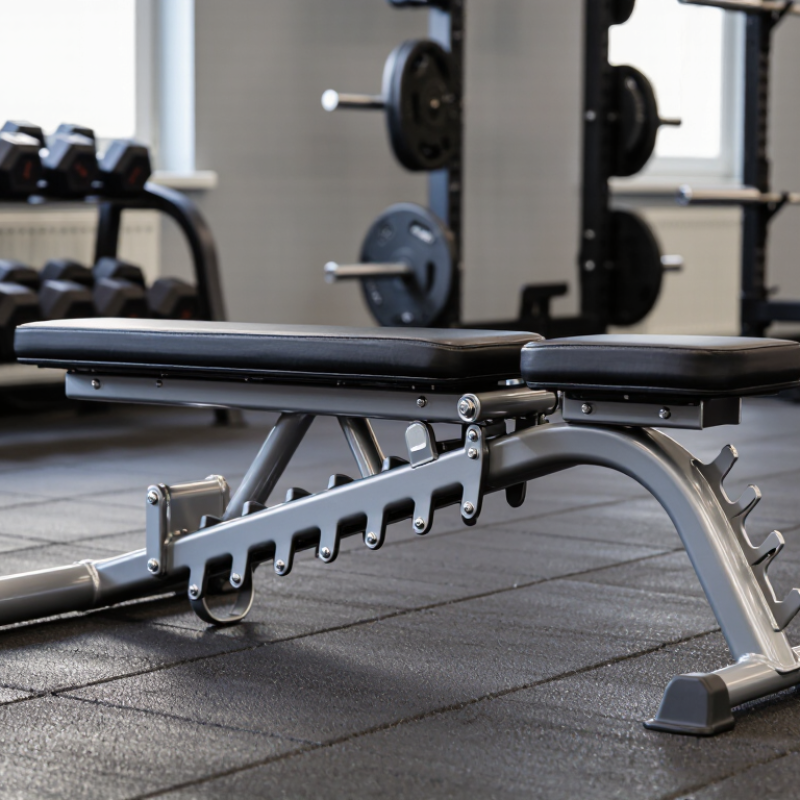
How to Choose an Adjustable Commercial Gym Bench?

Define Commercial Use: Apply EN ISO 20957-1/-2/-4 Safety Classes

How to Choose an Adjustable Commercial Gym Bench?

Define Commercial Use: Apply EN ISO 20957-1/-2/-4 Safety Classes

Commercial use means repeated loading, frequent adjustments, and many different users. EN ISO 20957-1 establishes general safety requirements. EN ISO 20957-2 covers stationary strength-training equipment. EN ISO 20957-4 applies specifically to weight benches. For a public gym, specify equipment tested for Class S, intended for professional and commercial use. Class H is designed for home environments and may not match daily facility demands.

Look beyond the label. Check the bench’s declared user-and-training load, frame stability, backrest locking, adjustment pin strength, and exposed pinch points. A supplier should provide conformity information, test documentation, and clear maintenance instructions. The EN ISO 20957 series does not replace responsible inspections. Bolts loosen. Padding compresses. I have seen a stable bench feel unsafe after a poorly maintained adjustment ladder.

Demand is also increasing. The SFIA 2024 Topline Participation Report recorded 72.9 million U.S. fitness-facility participants in 2023, up 5.8% from the previous year. That growth makes durability more than a purchasing preference. It affects availability and risk management. Ask whether the bench survives repeated drop-and-reset cycles, not only a single laboratory load. Confirm that the stated capacity includes the user’s body weight and lifted weight. A higher class does not rescue poor installation or neglected inspections. That part is easy to forget.

Use IPF Benchmarks: 122 cm Length, 29–32 cm Width, 42–45 cm Height

How to Choose an Adjustable Commercial Gym Bench?

Use IPF Benchmarks: 122 cm Length, 29–32 cm Width, 42–45 cm Height

An adjustable commercial gym bench should begin with stable proportions. Use 122 cm as a practical minimum length for proper back support. This measurement helps keep your head, shoulders, and hips comfortably aligned. A bench that is too short may leave your head unsupported during pressing. That small gap becomes irritating after repeated sets.

122 cm Practical minimum length for proper back support.
29–32 cm IPF benchmark for usable pad width.

Check the pad width carefully. The IPF benchmark is 29–32 cm. This range supports the upper back without restricting natural shoulder movement. Wider pads can feel secure, but they may interfere with arm position. Measure the usable padding, not the outer frame. Frames can look generous.

Height matters even more. Aim for 42–45 cm from the floor to the compressed pad surface. This range allows many users to plant their feet firmly. Stable foot contact improves pressing control and reduces unwanted movement. I once tested a bench that matched the advertised height, but its soft pad compressed noticeably. The real setup felt lower. That detail is easy to miss.

Adjustable mechanisms deserve close inspection. The backrest should lock firmly at every angle, with minimal side-to-side play. Check the hinge while applying steady body pressure. A slight wobble may seem harmless. In a busy facility, it can become a maintenance issue. Also inspect the rear support, wheel position, and frame welds. Precise dimensions help, but real stability decides whether the bench feels professional.

Evaluate Adjustability: Check Backrest Angles, Seat Support, and Locking Pins

Choosing an adjustable commercial gym bench starts with its adjustment system. Test each backrest angle before buying. A flat position should feel stable during presses and rows. Inclined positions must change smoothly without sudden drops. Count the available settings, but do not judge quality by numbers alone. The spacing between angles matters more than having excessive options.

Seat support deserves equal attention. Sit on the bench with your feet firmly planted. Your hips should stay supported when the backrest rises. A seat that tilts slightly can reduce sliding during incline exercises. Check its width, padding density, and edge shape. Soft padding may feel comfortable initially, but excessive softness can reduce balance under heavy loads. I once underestimated this issue during a long training session.

Inspect every locking pin closely. It should move easily, fit completely, and remain secure under repeated adjustments. Pull the pin gently after setting the angle. A loose mechanism is a warning sign. Also examine the hinge area for uneven gaps, exposed sharp edges, or excessive movement. Commercial equipment often receives frequent use, so small weaknesses can become serious maintenance problems.

Bring a measuring tape if possible. Compare the bench height with your rack and preferred lifting position. A bench can be well-built yet unsuitable for your body proportions. I have found that test demonstrations sometimes hide awkward setups. Try the bench yourself. Adjust it repeatedly. Listen for unusual clicks. These practical checks reveal more than specifications alone.

Audit Load Safety: Require ASTM F2276 Testing and Published Ratings

How to Choose an Adjustable Commercial Gym Bench?

A commercial bench must survive repeated loading, adjustment, and careless movement. Audit load safety before comparing upholstery or frame color. ASTM International’s F2276 specification covers fitness-equipment safety requirements and test methods. Ask whether the bench was tested against applicable F2276 provisions. Do not accept “commercial grade” as proof.

Published ratings should separate user weight from external load. A 300-kilogram total rating may include both. Request the test report, equipment identification, test date, applied load, cycle count, and pass/fail criteria. Check the adjustment ladder, hinge, welds, and transport wheels. A loose pin can turn a stable incline into a sudden drop. The U.S. Consumer Product Safety Commission’s 2021 NEISS-based report estimated more than 400,000 emergency-department-treated exercise-equipment injuries. That figure covers many equipment types, but it makes weak documentation difficult to dismiss.

Tips: Place the rating beside the bench during purchasing review. Confirm whether testing used a static load, repeated cycles, or both. Ask for independent laboratory evidence, not only an internal declaration. Measure the gap beneath the back pad; unstable contact can expose frame movement. Also inspect a production sample. Testing one prototype may not represent every shipment. That is an uncomfortable limitation, but it deserves attention. Check ASTM’s current edition and record your acceptance criteria before approval.

How to Choose an Adjustable Commercial Gym Bench?

Audit Load Safety: Require ASTM F2276 Testing and Published Ratings

This chart converts illustrative published bench loads from kilograms-force to newtons using standard gravity (1 kg = 9.80665 N). When evaluating an adjustable commercial gym bench, verify that the manufacturer publishes a clear load rating and provides documented testing to ASTM F2276. These calculations are load conversions, not ASTM pass/fail results.

Compare Materials: Assess Frame Steel, Upholstery Density, and Warranty Terms

How to Choose an Adjustable Commercial Gym Bench?

Frame steel deserves more than a “heavy-duty” label. Inspect tube dimensions, weld consistency, hinge play, and the support feet. ASTM F2276-14(2023), the Standard Specification for Fitness Equipment, provides a useful safety reference for commercial equipment. Ask for static-load testing and fatigue-test details. A thick frame can still fail when its adjustment mechanism is poorly designed. I once trusted weight alone. That was a mistake.

Upholstery affects comfort, stability, and service life. Request the foam density in kilograms per cubic meter, not only the thickness. Commercial benches commonly use high-resilience foam around 35–50 kg/m³, although density alone cannot predict comfort. Press the pad near the shoulder area. It should recover quickly without feeling like a hard block. Check vinyl seams, corner stitching, and the gap between back and seat. Small gaps collect sweat and cleaning residue. Foam quality is often overlooked.

Warranty terms should match real facility use. The Health & Fitness Association’s 2024 U.S. Health & Fitness Consumer Report recorded 72.9 million U.S. fitness facility members in 2023. That traffic can expose weak hinges and torn upholstery quickly. Separate coverage for the frame, moving parts, upholstery, and labor. Confirm whether the warranty permits commercial use. Ask about response times, replacement parts, and transport costs. A ten-year frame warranty sounds impressive, but it may exclude labor and adjustment hardware. Read the exclusions carefully.

How to Choose an Adjustable Commercial Gym Bench? — Compare Materials: Assess Frame Steel, Upholstery Density, and Warranty Terms

Evaluation Area Entry Commercial Standard Commercial Heavy-Duty Commercial What to Check Before Buying
Frame steel grade Carbon steel tubing, commonly equivalent to ASTM A500 structural tubing Structural carbon steel with documented tubing specifications Higher-strength structural steel with verified mill or material documentation Request the steel grade, tubing standard, and test or material certificate rather than relying on marketing terms such as “commercial grade.”
Main-frame tubing Approximately 50 × have 50 mm tubing with a wall thickness around 2.0 mm Approximately 50–75 mm tubing with a wall thickness around 2.5–3.0 mm Approximately 75 mm tubing with a wall thickness of about 3.0 mm or more Confirm whether the stated dimensions refer to the main frame, adjustment arms, or only decorative components.
Frame finish Powder-coated steel suitable for indoor use Thicker, chip-resistant powder coating with prepared and cleaned steel surfaces Commercial powder coating with enhanced corrosion resistance and documented coating process Ask about coating thickness, surface preparation, salt-spray testing, and touch-up procedures.
Upholstery foam density Approximately 28–32 kg/m³ polyurethane foam Approximately 32–40 kg/m³ polyurethane foam Approximately 40–50 kg/m³ polyurethane foam or a documented multi-layer construction Density alone does not determine comfort; also check foam thickness, firmness, compression recovery, and long-term fatigue performance.
Foam thickness Approximately 40–50 mm Approximately 50–60 mm Approximately 60–75 mm, depending on the bench design Check for uniform thickness, firm edge support, and no exposed hard points around hinges or mounting plates.
Upholstery cover PVC or polyurethane-coated synthetic leather, commonly around 0.6–0.8 mm thick Abrasion-resistant synthetic leather, commonly around 0.8–1.0 mm thick Commercial upholstery with reinforced seams and a documented abrasion or hydrolysis rating Look for sealed seams, tear resistance, easy cleaning, resistance to disinfectants, and suitability for frequent sweating.
Adjustment mechanism 5–7 backrest positions with a manual support bar 6–8 backrest positions, including flat and incline settings 7–10 positions with reinforced pivot points and low-play locking hardware Test locking pins, welds, hinges, and adjustment stability under load; the bench should not shift or rock between positions.
Typical rated user and training load Often specified around 250–350 kg total, including user and weights Often specified around 350–450 kg total, including user and weights Often specified above 450 kg total, subject to independent testing and manufacturer limits Verify whether the rating is a static load, a dynamic load, or a combined user-and-weight limit.
Stability features Rubber feet and a basic welded base Wide footprint, non-marking feet, and reinforced base joints Wide reinforced base, replaceable feet, and tested resistance to rocking under uneven loading Inspect the contact points, floor clearance, weld quality, and compatibility with rubber gym flooring.
Typical warranty structure Frame: about 3–5 years; upholstery and moving parts: about 1 year Frame: about 5–10 years; upholstery and moving parts: about 1–3 years Frame: about 10 years or longer; upholstery and moving parts: about 2–5 years Confirm coverage for commercial use, labor, shipping, welds, adjustment hardware, upholstery, misuse, and corrosion.
Best fit Low- to moderate-use facilities with controlled traffic Most gyms, studios, hotels, schools, and apartment fitness rooms High-traffic gyms, athletic facilities, and 24-hour training centers Match the construction level to daily users, cleaning frequency, average training loads, and expected service life.

Note: The figures above are typical commercial specification ranges rather than measurements from a specific company or brand. Exact performance depends on design, manufacturing quality, testing method, maintenance, and the supplier’s written warranty.

FAQS

What bench dimensions support stable pressing?

Look for about 122 cm of usable length. This supports your head, shoulders, and hips. The pad should measure 29–32 cm wide. A 42–45 cm compressed height usually allows firm foot contact. These figures guide selection, not guarantee perfection.

Why does compressed pad height matter?

Soft padding can lower the actual setup height. Measure from the floor to the compressed surface. Your feet should stay flat during pressing. That improves control. Advertised measurements can be slightly misleading.

How can I inspect the adjustment mechanism?

Lock the backrest at every available angle. Apply steady body pressure near the hinge. Watch for side-to-side movement. A small wobble today may become a repair problem later. I would not ignore it.

What load information should a commercial bench provide?

Request separate ratings for user weight and external weight. A total rating may combine both figures. Ask for test loads, cycle counts, dates, and pass criteria. Review the hinge, adjustment ladder, welds, and wheels. “Commercial grade” alone proves very little.

Should testing cover repeated use?

Yes. A bench faces repeated loading and frequent adjustments. Ask whether testing included static loads, repeated cycles, or both. Independent laboratory evidence is more convincing than an internal statement. Still, one tested sample may not represent every shipment.

What frame details deserve close inspection?

Check tube dimensions, weld consistency, support feet, and hinge clearance. A heavy frame can still have a weak adjustment design. Move the bench gently across the floor. Notice flex, rattling, or uneven contact. Weight is not the whole story.

How should I evaluate upholstery?

Ask for foam density in kilograms per cubic meter. Around 35–50 kg/m³ is common for durable commercial padding. Press near the shoulder area. The foam should recover quickly without feeling rigid. Inspect seams, corner stitching, and the seat-back gap. Sweat collects there.

What warranty details should a facility confirm?

Separate coverage for the frame, moving parts, upholstery, and labor. Confirm that commercial use is included. Ask about replacement parts, response times, and transport costs. A long frame warranty may exclude hinges and labor. Read every exclusion. That part is easy to miss.

Conclusion

Choosing an Adjustable commercial gym bench requires more than comparing prices or appearance. First, define whether the bench is suitable for commercial use by checking its alignment with EN ISO 20957-1 and EN ISO 20957-2/-4 safety classes. Use IPF-inspired benchmarks as a practical reference: approximately 122 cm in length, 29–32 cm in width, and 42–45 cm in height. A well-designed bench should offer useful backrest angles, stable seat support, and secure locking pins that remain firm during repeated adjustments.

Load safety is equally important. Look for evidence of ASTM F2276 testing, clearly published weight ratings, and a design that remains stable under demanding training conditions. When comparing models, assess the frame steel for strength and corrosion resistance, the upholstery density for comfort and durability, and the warranty terms for long-term value. A suitable bench should combine reliable adjustability, strong construction, comfortable support, and transparent safety information for consistent commercial operation.

Isla Monroe

Isla Monroe

Isla Monroe is a professional marketing specialist who combines a strong understanding of product features with a practical perspective on customer needs. She regularly contributes expert articles to the company’s blog, creating clear, useful content that helps readers understand products, compare......